Views: 0 Author: Site Editor Publish Time: 2026-11-18 Origin: Site
Step onto the floor of any modern mineral processing facility or cement plant. The deafening roar of the tumbling mills immediately tells a story of immense kinetic energy. Inside these massive rotating cylinders, tons of steel media relentlessly crush and grind raw materials. Yet, a pervasive misconception plagues many procurement departments. They assume all grinding shapes—whether spherical or cylindrical—require the exact same chemical composition. The unforgiving physics of comminution proves otherwise.
Geometry dictates mechanical behavior. When operators utilize incorrectly specified chrome levels for cylindrical media, they inadvertently accelerate wear rates and trigger premature breakage. This ultimately burns through substantial operational budgets. By abandoning a one-size-fits-all methodology, plant engineers can optimize alloy content to match the specific physical demands of the media shape. Exploring the nuanced mechanical realities of the mill chamber reveals exactly why tailoring the metallurgy to the geometry is an absolute necessity for maximizing grinding efficiency.
Surface Area Dynamics: Cylinders operate primarily through line and face contact. This fundamental geometric difference dictates that they require entirely different alloy properties compared to the concentrated point contact of traditional grinding balls.
Impact vs. Abrasion: The lower impact energy required for secondary grinding stages allows metallurgists to shift away from ultra-high chrome formulations. Moving toward optimized medium chrome ranges better suits the kinematics of the mill.
Cost-Efficiency: Utilizing medium chrome alloys provides a highly balanced hardness-to-toughness ratio. This specific metallurgical balance outperforms high-chrome alternatives in fine grinding stages by preventing premature edge chipping.
Longevity and Breakage Prevention: Maintaining proper chrome levels prevents brittle failure in non-impact intensive zones. Preserving the structural integrity of the cylindrical shape remains critical for maintaining maximum grinding efficiency over the lifespan of the media.
Total Cost of Ownership: Aligning the chrome chemistry with the physical shape of the media significantly reduces the cost per ton of processed material without compromising wear resistance.
To fully grasp why chemical composition must be tailored to shape, one must first examine the kinematics inside a tumbling mill. The size reduction process relies entirely on the transfer of kinetic energy from the grinding media to the ore or clinker. Because this energy transfer occurs at the exact point of collision, the surface area of that collision drastically alters the resulting stress distribution within the metal.
Spherical grinding balls rely exclusively on point contact. Imagine a large steel ball dropping directly onto a heavy mill liner. The kinetic energy concentrates into a microscopic focal point. This generates extreme localized stress, which is highly effective for shattering large, coarse particles during primary grinding. Consequently, this high-impact environment requires the spherical media to possess specific structural toughness to prevent catastrophic shattering under immense localized pressure.
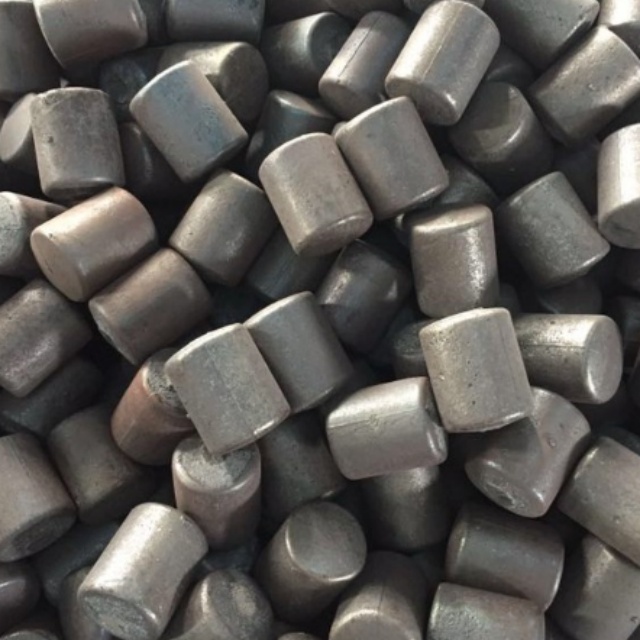
In contrast, cylpebs feature a distinct cylindrical geometry. During the cascading and cataracting motion within the mill, they naturally tend to align along their longitudinal axes. This alignment creates continuous line contact or face-to-face surface contact. By distributing the impact force over a significantly broader surface area, the localized stress drops dramatically.
Because the acute stress is lower, the primary wear mechanism shifts away from high-impact fatigue and gouging. It moves instead toward continuous surface abrasion. The unique collision mechanics of grinding media cylpebs necessitate a carefully tailored chemical composition. If a foundry engineers an alloy strictly for high-impact point contact, that steel will perform sub-optimally in an abrasive line-contact environment.
Feature | Grinding Balls | Grinding Cylpebs |
|---|---|---|
Primary Geometry | Spherical | Cylindrical |
Contact Type | Point Contact | Line and Face Contact |
Stress Distribution | Highly concentrated | Broadly distributed |
Primary Wear Mechanism | Impact fatigue and gouging | Surface abrasion and rubbing |
Optimal Application | Primary crushing for coarse feeds | Secondary and fine grinding |
During the manufacturing of cast grinding media, chromium and carbon act as the primary alloying elements that dictate ultimate performance in the mill. When chromium is introduced to the molten iron melt, it aggressively bonds with carbon to form hard chromium carbides deep within the metallic matrix. Complex structures like M7C3 carbides emerge during this phase.
These carbides are exceptionally hard. They often reach micro-hardness levels of 1500 to 1800 HV, arming the media with superior resistance against relentless abrasive wear. Meanwhile, the surrounding metallic matrix, typically tempered martensite or bainite, provides the essential ductility to absorb operational impacts without fracturing.
Metallurgy demands a strict trade-off. Push the chrome and carbon content higher, and you increase the volume fraction of hard carbides. Wear resistance goes up. Unfortunately, so does the brittleness of the casting.
For large spherical balls operating in highly abrasive yet low-impact environments, elevating the chrome content to 15 percent, 20 percent, or even 27 percent often yields excellent wear rates. The spherical shape naturally lacks weak geometric points, allowing it to safely handle higher brittleness. Yet, applying this more-is-always-better logic to cylindrical shapes is a costly metallurgical misstep. Cylinders possess sharp edges and flat faces that act as natural stress concentrators. Should the alloy become too brittle from excessive chrome, those critical edges will inevitably chip and spall under the heavy tumbling action of the mill charge.
Recent market analyses reveal a significant shift in global comminution strategies. Mining and cement operations face mounting regulatory pressure to reduce energy consumption and lower their carbon footprints. Consequently, the historic reliance on universally applied, over-specified high-chrome media is rapidly fading.
Today, metallurgical engineers increasingly adopt highly specific, compartment-tailored chemistries. The modern consensus prioritizes sustained geometric integrity over raw hardness. Plants now audit their specific mill environments, recognizing that deploying premium high-chrome steel in a low-impact attrition zone wastes both capital and energy. This targeted approach to alloy selection directly supports broader industry goals of lowering the kilowatt-hour per ton of processed material.
For cylindrical media, the structural integrity of the edges is absolutely paramount. If a cylinder chips and loses its distinct profile, it slowly rounds into an irregular, pebble-like shape. Once this degradation occurs, the crucial line-contact advantage vanishes. The mill's grinding efficiency plummets immediately.
This operational reality explains why medium chrome grinding cylpebs represent the optimal engineering solution for fine grinding circuits. Specifically, these alloys strike a flawless metallurgical balance. Engineered with a chromium content ranging from 4 percent to 10 percent, they achieve a robust surface hardness of 45 to 58 HRC. Foundries generate a strong network of primary and secondary carbides capable of resisting the abrasive rubbing of fine clinker.
Simultaneously, the matrix retains ample ductility. By maintaining an impact toughness of greater than or equal to 3.0 Joules per square centimeter, the breakage rate remains strictly under 1 percent. The practical benefits of operating within this metallurgical sweet spot include:
Edge Retention: The properly tempered matrix prevents micro-cracking at the sharpest points of the geometry.
Uniform Wear: As the media wears down over thousands of operational hours, it maintains its relative cylindrical proportions rather than fracturing into irregular shards.
Thermal Stability: Mid-range alloys respond exceptionally well to controlled quenching and tempering, allowing for a deep, volumetric hardness that does not rely solely on a brittle outer shell.
Selecting the correct media is never a simple administrative task. Procurement engineers must rigorously evaluate the specific compartmental dynamics of their milling circuits to pinpoint the correct alloy.
In the first compartment of a large ball mill, coarse feed particles require massive kinetic energy to fracture. Here, large diameter balls are lifted high and dropped directly onto the rock. This violent, high-impact zone demands maximum toughness. Cylindrical shapes are rarely deployed in this primary stage. Furthermore, ultra-high-chrome alloys are frequently avoided for larger balls due to the severe risk of catastrophic splitting.
However, as the material passes into the second or third compartments, the dynamic changes entirely. The feed material has already been reduced to a coarse powder. The mechanical goal shifts from crushing to attrition, rubbing the particles down to their final liberation size. This specific environment is the undisputed domain of fine grinding media.
Because the particles are already small, the media size is proportionally reduced. Impact forces drop to a minimum, while abrasive friction skyrockets. Deploying expensive high-chrome balls in a compartment specifically designed for line-contact attrition results in severe over-engineering. High-chrome alloys carry a premium price tag due to the cost of raw ferrochrome. If a mid-range chrome cylinder can achieve the required wear rate while flawlessly maintaining its shape, utilizing a high-chrome alternative introduces unnecessary cost bloat without delivering a proportional increase in operational lifespan.
In the realm of industrial procurement, the initial invoice price of grinding media represents only a fraction of the Total Cost of Ownership. The true, defining metric of operational success is the actual cost per ton of material ground.
Optimizing the chrome range directly and immediately impacts this financial metric. High-chrome alloys command premium market prices. Plant managers who unnecessarily specify them pay heavily for extreme abrasion resistance that their specific mill compartment may not even require. Furthermore, if those highly brittle cylinders chip and lose their shape, the mill's energy consumption actively increases due to plunging comminution efficiency. The plant ends up paying more for the steel and significantly more for the electricity required to run the mill.
Conversely, appropriately specified media reduces the initial capital outlay of the inventory. When paired with advanced heat treatment processes, such as precise oil quenching or controlled air cooling, these alloys easily achieve surface hardness levels that are more than adequate for fine attrition tasks.
Cost Factor | High-Chrome Cylpebs | Medium Chrome Cylpebs |
|---|---|---|
Initial Purchase Price | High due to premium raw materials | Moderate and highly cost-effective |
Shape Retention | Poor due to high risk of edge chipping | Excellent as the tough matrix supports edges |
Grinding Efficiency | Decreases over time due to chipping | Remains stable due to uniform wear |
Energy Consumption | Increases as media loses line contact | Optimized through sustained line contact |
Overall TCO per ton | Sub-optimal for fine grinding | Highly efficient |
The specific failure mode of the media ultimately dictates the stability of the entire mill circuit. When evaluating performance, engineers generally categorize wear into two distinct outcomes: uniform wear and premature failure, such as spalling, chipping, or splitting.
Uniform wear is the engineered outcome. The steel slowly reduces in size over months of continuous friction. It maintains its functional geometry until it is small enough to be safely purged from the mill charge. Premature failure, particularly spalling where flakes of metal physically peel off the surface, proves highly detrimental. Because cylindrical shapes possess a larger surface-area-to-mass ratio than spheres, they are inherently more sensitive to sudden material hardness variations and internal casting stresses.
A balanced chrome range acts as a vital metallurgical buffer. It makes the foundry casting and heat treatment processes significantly more forgiving, ensuring a homogenous microstructure from the outer surface straight through to the core. To actively minimize wear rates, operators must implement rigorous best practices. Shut the mill down, lock it out, and visually inspect the equilibrium charge during periodic crash stops. Measure the physical dimensions of worn pieces, and adjust replenishment rates based on hard empirical data rather than theoretical estimates.
Procuring the correct steel is a critical engineering decision that dictates the efficiency of your milling circuit. When transitioning to or optimizing the use of medium chrome alloys, procurement managers must evaluate potential manufacturing partners through a strictly technical lens.
Unlike forged media, cast products require hyper-precise control over pouring temperatures, cooling rates, and mold conditions. When auditing a potential supplier, request detailed documentation regarding their foundry processes. Automated pouring systems generally yield far fewer internal casting defects, such as shrinkage cavities or porosity, which often act as stress concentration points leading to premature spalling.
Additionally, a standard chemical composition sheet is necessary but rarely sufficient. While a supplier might guarantee a chrome content of 6 percent to 10 percent, the actual in-mill performance is dictated by the microstructure. Engineers must ask for micrograph reports showing a fine, evenly distributed network of complex carbides embedded in a tough martensitic or bainitic matrix. If the carbides are excessively large or form continuous networks along the grain boundaries, the metal will become brittle regardless of its overall chemical makeup.
Evaluation Criteria | Technical Requirement | Impact on Mill Performance |
|---|---|---|
Chemical Composition | Strict adherence to specified Carbon and Chrome ranges. | Ensures the baseline hardness and wear resistance are appropriate for secondary grinding. |
Microstructure | Martensitic matrix with evenly dispersed, discontinuous complex carbides. | Prevents brittle failure, ensures uniform wear, and maintains the cylindrical shape longer. |
Heat Treatment | Documented quenching and tempering cycles with verifiable holding times. | Relieves internal casting stresses, maximizing the toughness-to-hardness ratio. |
Volumetric Hardness | Consistent hardness from the surface to the core. | Prevents accelerated wear rates once the outer surface is ground away. |
The selection of a specific chrome range is far from an arbitrary purchasing decision. It is a highly calculated engineering necessity dictated by mill loads and internal contact mechanics. While high-chrome spherical balls undeniably hold their rightful place in primary, high-impact milling zones, medium chrome cylindrical solutions offer vastly superior efficiency for fine grinding applications. By perfectly balancing hardness with structural toughness, these specialized alloys prevent premature edge chipping, maintain their critical line-contact geometry longer, and provide a highly cost-effective operational advantage.
Plant managers must conduct regular wear-rate audits and physical charge inspections to ensure their current chrome-to-shape ratio is truly optimized. Ready to enhance your mill's grinding efficiency and lower your total cost of ownership? Visit https://www.jinqiaocasting.com to consult with metallurgy experts and explore a complete range of precision-engineered grinding media tailored to your specific application.
The industry-standard chrome range typically falls between 4 percent and 10 percent, though exact specifications can vary slightly based on the manufacturer and the specific application. This range is strategically positioned between low chrome media, which is highly susceptible to rapid abrasive wear, and high chrome media, which offers maximum hardness but lower impact toughness. For the line-to-line and face-to-face contact mechanics inherent to cylindrical shapes, this mid-range provides optimal performance. It allows the formation of enough chromium carbides to resist severe abrasion while keeping the alloy ductile enough to prevent snapping under compressive stress.
While you physically can load high-chrome balls into a secondary or tertiary mill compartment, doing so often results in a distinct loss of grinding efficiency and unnecessary operational costs. Grinding balls operate on a point-contact mechanism, which is less effective at crushing fine particles compared to line and surface contact. Furthermore, high-chrome balls are engineered for maximum wear resistance in high-impact zones and are priced accordingly. Using them in a low-impact, abrasion-focused zone constitutes over-engineering, inflating your total cost of ownership without yielding a proportional increase in discharge fineness.
The geometry of a cylinder dictates an entirely different wear pattern than a spherical ball. Balls wear relatively uniformly across their entire surface due to their symmetrical shape. Cylinders, however, interact through line-to-line, face-to-face, and edge-to-face contacts. Because the edges and flat faces bear different types of stress, they require a metallurgical structure that resists uneven deformation. A medium chrome formulation ensures that the media retains its cylindrical geometry for a longer portion of its lifecycle, maintaining the high surface-area-to-volume ratio required for efficient fine grinding.
No, evaluating performance solely on chromium percentage is a significant metallurgical oversight. While chrome is the primary driver for carbide formation, overall performance depends on a complex interplay of several elements. Carbon content is equally critical, as it bonds with the chrome to form wear-resistant carbides. Manganese improves hardenability, while silicon acts as a deoxidizer during casting. Beyond chemistry, the manufacturing process, specifically the cooling rate during casting and the precision of the subsequent heat treatment, ultimately dictates the final hardness and toughness.
The most empirical way to verify your media selection is by conducting routine wear-rate audits and mass balance tests. Start by performing a marked media test. Introduce a known quantity of weighed, marked pieces into the mill, and retrieve them after a set number of operational hours to measure exact mass loss. Additionally, visually inspect the media during mill stoppages. If you observe excessive spalling, chipping, or pieces snapping in half, your media is likely too brittle. Conversely, if they are losing their shape rapidly and wearing down into spheres without breaking, the alloy is too soft. Consistent monitoring of mill discharge fineness alongside consumption rates will provide the data needed to optimize your selection.
Forged balls are manufactured by heating high-carbon alloy steel rods and stamping them into spheres, which aligns the internal grain structure for high impact resistance. Cylpebs, on the other hand, are exclusively cast in foundries using molten iron alloyed with chromium and carbon. This casting process allows for the precise creation of complex chromium carbides required for superior abrasion resistance in fine grinding. While forging is excellent for creating tough, primary-stage balls, casting is the only way to achieve the specific geometrical and metallurgical properties required for secondary cylindrical media.
The optimal filling degree for cylindrical media in the fine grinding compartments of a cement tube mill generally ranges from 28 percent to 32 percent of the mill's internal volume. Exceeding this ratio can lead to media-on-media wear rather than media-on-clinker grinding, wasting kinetic energy and increasing the risk of edge chipping. Conversely, a filling ratio that is too low will drastically reduce the mill's throughput. Engineers must constantly monitor the equilibrium charge and adjust the replenishment rate to maintain this optimal volume for maximum attrition efficiency.