Views: 0 Author: Site Editor Publish Time: 2026-11-13 Origin: Site
Social media feeds are often filled with viral clips of bowling balls bouncing on trampolines or glass shattering from record heights. While these spectacles draw millions of views, they bear little resemblance to the high-stakes reality of industrial manufacturing. In sectors like mining, cement, and power generation, the objective isn't entertainment; it is the pursuit of relentless, profitable operations.
Inside a roaring industrial mill, a single shattered piece of media is a liability. Steel fragments can wedge into discharge grates, accelerate the wear of expensive mill liners, and force multi-million dollar production lines to a grinding halt. To mitigate these risks, engineers rely on the industrial falling ball impact test. This scientific benchmark determines whether ball mill grinding balls can withstand the intense, cyclic stresses of a heavy-duty production environment.
The industrial drop test serves as the gold standard for verifying the structural integrity of grinding media. Unlike theoretical simulations, this test generates empirical data that static hardness testing simply cannot replicate.
A typical falling ball impact tester operates by hoisting a steel or iron ball via a magnetic mechanism and releasing it onto a heavy steel anvil. This isn't a one-off performance; it is a continuous, automated loop. While academic physics might focus on the coefficient of restitution, industrial testing concentrates strictly on fatigue, fracture mechanics, and the point at which internal stresses trigger a structural failure.
To truly grasp the significance of these tests, one must visualize the internal dynamics of an active mill. As the shell rotates, lifters carry the media to a specific elevation before gravity takes over. The balls cascade or "cataract" downward, slamming into raw ore and other media. The drop test effectively isolates this vertical impact, allowing metallurgists to predict whether the grinding balls will endure months of non-stop operation without fragmenting.
Procurement teams often face the same pivotal question: what drop height provides genuine assurance against shattering? The industry standard generally relies on a range of 3.5 to 8 meters, a parameter dictated by the physical dimensions of the milling equipment and the mass of the media itself.
This range is far from arbitrary. It accurately mimics the kinetic energy a ball encounters in large-diameter SAG mills. For instance, in a 5-meter diameter mill, the internal charge volume limits the free-fall distance. Testing at 8 meters establishes a robust safety buffer, ensuring the material remains well below its fracture threshold even under peak operating conditions.
It is worth noting that the global mining industry is currently trending toward larger, high-capacity equipment. As we see mills reaching diameters of 12 meters or more, the potential free-fall distance inside the chamber has increased significantly. Consequently, there is a growing push to refine these testing standards, moving toward higher-energy impact simulations to ensure that modern, ultra-durable media can keep pace with these massive, high-throughput systems.
Furthermore, reliability is not defined by surviving a single extreme event; it is defined by fatigue life. Surviving a single, one-off impact proves very little. The real benchmark for quality is the ability to withstand 10,000 to 20,000 consecutive cycles. If the internal grain structure is stable, it prevents micro-cracks from propagating. This level of consistency is exactly what separates high-performance media from standard alternatives.
When a ball shatters during a test, it is rarely due to a single cause, but rather a failure to manage the metallurgical trade-off between hardness and toughness. If you engineer a ball to be excessively hard, it becomes brittle; it cannot deform plastically to absorb shock, so it simply snaps.
The solution lies in precise heat treatment. Manufacturers use quenching and tempering to produce a fine martensitic microstructure. This grants the surface the hardness needed for abrasion resistance, while the core retains enough toughness to dampen kinetic energy. When this balance is missed, or when casting defects like porosity and shrinkage occur, the ball develops stress risers. During the drop test, these microscopic voids act as focal points for energy, causing the ball to split after repeated strikes.
Manufacturing techniques define how a ball responds to kinetic stress. Forged media typically enters the market with a reputation for high-impact durability. Because the process involves compressing a hot billet under immense mechanical force, it effectively closes internal voids and aligns the grain flow to the ball's shape. This leads to a dense, uniform structure capable of surviving tens of thousands of drops, making it the preferred choice for heavy-duty SAG mills.
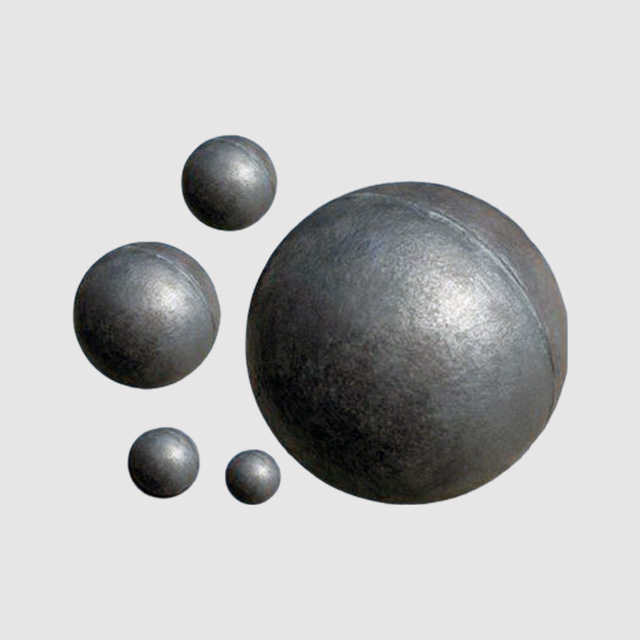
In contrast, cast media has evolved significantly. While historically seen as more brittle, modern casting has integrated sophisticated alloying and multi-stage heat treatments. These processes successfully break up brittle carbide networks and disperse them uniformly. As a result, today’s premium China Grinding Balls offer impressive wear resistance while meeting the strict impact standards previously reserved only for forged products.
To compete on a global scale, top-tier foundries have moved beyond manual testing. They now rely on automated, PLC-controlled impact systems that run around the clock. These machines use acoustic sensors to detect even the faintest sound of a micro-crack forming, effectively removing human error from the data set.
In addition to these impact cycles, quality assurance is integrated into every stage of production. From spectrometer analysis of the raw alloy to Rockwell hardness tests that ensure there are no soft spots in the core, the goal is near-zero breakage. If a sample fails, the entire batch is flagged for review. This systemic approach is the only way to ensure that the material reaching the end-user is truly fit for purpose.
Procurement managers should treat drop test reports as essential documentation, not optional paperwork. When evaluating a supplier, look for an impact toughness value of at least 12 J/cm² and certification that samples have endured at least 10,000 drops without failure.
It is also vital to align your media choice with the specific geometry of your mill. A 7-meter mill with a low fill ratio will produce vastly different impact forces than a high-charge volume setup. By matching the ball's tested fatigue life to the physical reality of your equipment, you can effectively optimize your wear life while maintaining a comfortable margin of safety. If you are uncertain about the right specifications for your mill, it is highly recommended to consult with technical specialists who can review your mill's drop height data and operational requirements to provide the most durable solution.
A high-quality grinding ball should generally demonstrate an impact toughness of ≥ 12 J/cm². This ensures the internal structure is robust enough to absorb the shock of repeated high-energy drops without shattering.
In a standard falling ball impact fatigue test, a sample is typically dropped between 10,000 and 20,000 times from a predetermined height. This exhaustive repetition is necessary to verify long-term shatter resistance and fatigue life.
Yes. Larger balls possess more mass, which generates significantly more kinetic energy upon impact. Consequently, testing parameters and heat treatments must be adjusted based on the ball's diameter to ensure uniform performance.
Shattering is usually caused by excessive brittleness from improper heat treatment, internal casting defects like gas porosity, or using a ball that is not rated for the high-impact intensity found in large-diameter mills.
Yes, reputable manufacturers utilize advanced, automated falling ball impact testers and strict metallurgical processes. These quality control measures ensure that products meet or exceed global standards for durability and operational efficiency.